Why Anchoring One Weekly Night Around a Shared Household Ritual Quietly Reduces Friction, Spending, and Decision Fatigue
Robert Kim
10/09/2026
5 min read
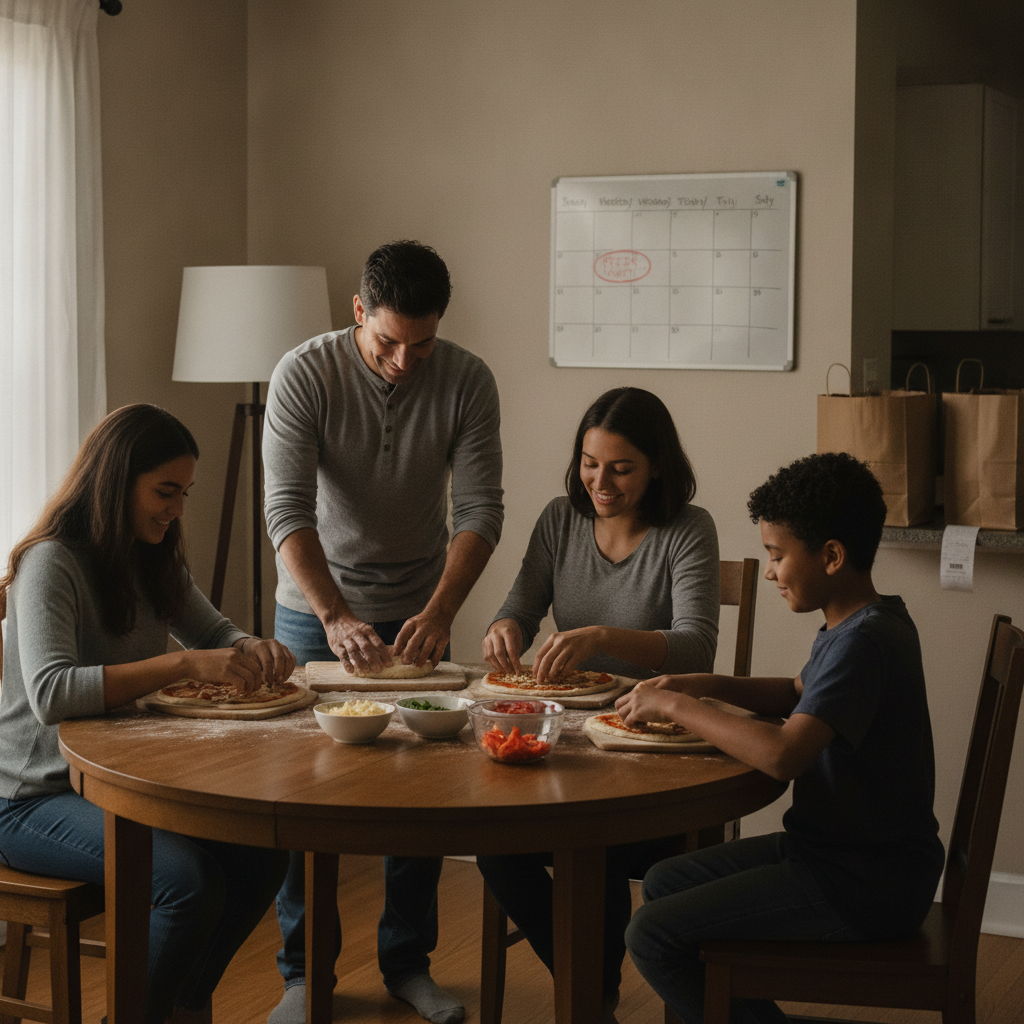
There is a particular exhaustion that settles into a household not from overwork or crisis, but from the accumulated weight of small, unresolved decisions. What to eat tonight. Whether to order in again. Who handles which errand, and when. These micro-negotiations, repeated across the week without any governing structure, quietly drain energy that households rarely think to protect. The solution, as it turns out, doesn't require an app, a system, or a significant financial investment. It requires something far simpler: one recurring evening anchored around a shared ritual that the whole household can anticipate, prepare for, and rely upon.
The Accumulation of Low-Grade Household Friction
Psychologists and behavioral economists have long observed that decision fatigue — the deterioration of decision quality that follows a long sequence of choices — doesn't discriminate between high-stakes and trivial decisions. The mind taxes both equally. For households juggling work schedules, meal planning, and social obligations, the sheer volume of small choices each evening becomes its own form of chronic stress. Takeout spending tends to spike not because people crave restaurant food, but because the effort of deciding what to cook, and then actually cooking it, exceeds the mental reserves available after a full day. A weekly ritual interrupts this cycle by removing one evening's worth of decisions entirely, replacing open-ended uncertainty with settled expectation.
Ritual as Financial Architecture
The concept of a household ritual as a financial tool might seem like a stretch, but the connection is more direct than it appears. When one evening per week is pre-decided — a homemade pasta night, a board game evening with a specific simple dinner, a slow Sunday soup ritual — the spending default shifts. Households that structure even one predictable evening around a home-based activity consistently spend less on that night than they would navigating an unstructured one. Platforms like Notion or even a simple shared Google Calendar become useful here, not for tracking spending, but for holding the ritual in place when schedules try to crowd it out. The ritual becomes, in effect, a recurring budget line that costs almost nothing and delivers disproportionate returns in both connection and calm.
There is also something worth understanding in the Japanese concept of ma — the intentional use of negative space or pause — which applies elegantly to household rhythm. Ma is not emptiness but structured openness, a deliberate gap that gives surrounding activity meaning. A weekly household ritual functions similarly: it creates a pause in the week's momentum that makes everything else feel more intentional. When households in cities like Portland or Edinburgh report that they've reduced their mid-week takeout habit, the cause is rarely discipline. It's structure. One anchored evening reshapes the gravitational pull of the entire week around it.
What the Ritual Actually Looks Like
The specific form a household ritual takes matters less than its consistency and its shared ownership. Some households anchor Wednesday evenings around a rotating cook-in, where whoever chooses the meal also chooses something simple enough to make without stress. Others build a Friday evening ritual around a film and a specific homemade snack — popcorn from a stovetop, a particular dip, something with the quality of a small ceremony. The ritual works not because of its content but because of its reliability. Meal kit services like Green Chef or HelloFresh are sometimes useful in the early stages, providing a structured recipe that removes the planning burden without requiring inspiration. But over time, the ritual often outgrows external props and becomes self-sustaining, driven by the pleasure of repetition rather than novelty.
What the ritual quietly eliminates is the negotiation tax. In households without structure, every evening involves a micro-negotiation: what to eat, who makes it, whether to spend money doing so. These negotiations are rarely contentious, but they are consistently draining. The pre-decided evening removes that tax entirely. The household arrives at a known destination rather than an open question, and the energy saved accumulates in ways that are felt before they're measured.
The Compound Effect on Weekly Spending Patterns
One structured evening doesn't just protect its own budget — it tends to reshape the rhythm of the whole week. Households that anchor one night create a psychological anchor point that makes the surrounding evenings feel less chaotic by contrast. Grocery shopping becomes slightly more purposeful when one evening's menu is already settled. The impulse to order delivery on a Tuesday feels less automatic when there's a known Wednesday ritual to look forward to. In behavioral terms, this is sometimes called temporal landmarks — fixed points in time that restructure how people plan and behave around them. A weekly ritual functions as one of these landmarks, giving the week a shape that loose, unstructured evenings cannot provide.
Over months, this effect compounds. Households that might once have ordered takeout three or four times a week find themselves gravitating toward two, simply because one evening is already settled and the ritual's warmth lingers into the next day. The savings are real without ever being calculated, which is precisely what makes them sustainable.
If you've been meaning to try this but haven't found the right entry point, the simplest starting place is a single weeknight — Thursday tends to work well, as it sits close enough to the weekend to feel like a mild celebration without losing momentum. Choose one format: a specific cuisine, a recurring activity, a shared effort in the kitchen. Keep it low-threshold at first. The ritual's power comes not from its ambition but from its return. Week after week, the same evening arrives like a quiet landmark in the calendar, and the household moves toward it without negotiation, without decision fatigue, and without reaching for a delivery app. Over time, that single evening becomes one of the week's most anticipated hours — not because it's elaborate, but because it's reliably, dependably, already decided.
The exhaustion that settles into households from unresolved small decisions doesn't lift all at once. But give the week one evening that asks nothing new of anyone, one night that arrives already formed and familiar, and something in the household's collective posture begins, slowly, to ease.